Key takeaways
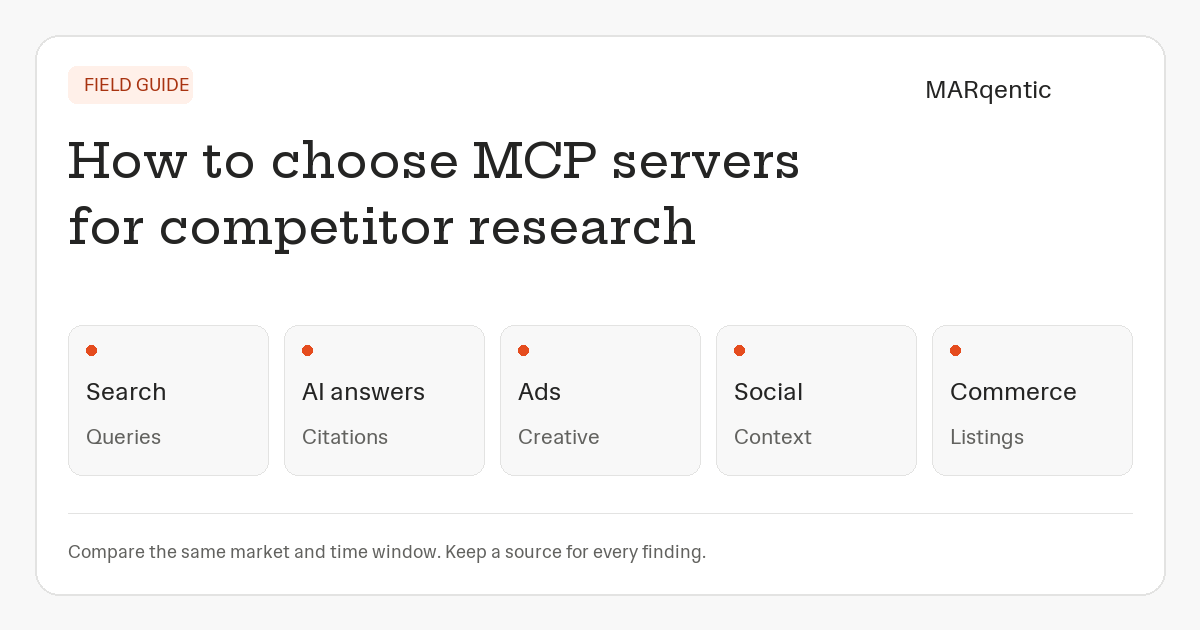
- Competitor research is five separate jobs: search visibility, AI answer visibility, paid creative, social and community, and marketplaces. No single data source covers all of them equally well.
- Judge an MCP server by whether every number can be traced to a source, a market and a date, not by how many tools it lists.
- Fix one market, one language and one time window before comparing competitors, or the differences you find will be artifacts of the sample.
- Keep research servers read-only. Connect anything that can publish, send or spend only after the research is trusted.
What competitor research with an MCP server actually means
The Model Context Protocol (MCP) lets an AI assistant such as Claude or ChatGPT call external tools during a conversation. For competitor research, that means the assistant can pull live search, advertising and social data instead of summarizing whatever it remembers from training. The difference matters: a remembered answer about a competitor can be months out of date, while a tool call returns what is visible today.
It also changes your job. The assistant will happily write a confident competitor summary from thin evidence. Your task is to decide which sources count as evidence, ask for them explicitly and check that the final write-up matches what the tools returned.
This MARqentic guide compares research approaches, not a tested shortlist of competing products. Check the protocol and tool definitions before selecting a server:
The five layers of competitor data
Before comparing servers, list the questions you need answered. Most competitor questions fall into five layers, and each one is served by a different kind of data.
| Layer | Question it answers | Evidence to collect | Typical data source |
|---|---|---|---|
| Search visibility | Which queries and pages bring competitors traffic? | Ranking keywords, top pages, backlinks, estimated traffic | SEO data provider |
| AI answer visibility | Who do ChatGPT, Gemini and Google AI answers recommend? | Answer text, mentions, cited URLs, the exact question asked | AI answer and citation tracking |
| Paid creative | What offers and messages are competitors advertising? | Public ad creative, formats, landing pages, run dates | Ad transparency libraries |
| Social and community | What do buyers say about competitors and where? | Posts, comments and threads with original context | Social and forum research tools |
| Marketplaces and local | How do competitors look where people buy? | Listings, prices, reviews, app store pages, Maps profiles | Marketplace, app store and Maps data |
How to evaluate an MCP server for competitor research
A long tool list looks impressive but says little about quality. These six checks separate a useful research server from a demo.
- Coverage you can name. Know which engines, countries, languages and platforms each tool supports, and where it stops. A tool that fails silently outside its coverage is worse than one that says so.
- Traceable evidence. Every claim should link back to a returned record: a URL, an ad, a post or a ranking with its date. If you cannot trace a sentence in the final report to a tool result, do not publish it.
- Explicit context. Look for required market, language and device parameters. Results from different contexts are not comparable.
- Cost you can see before you spend. Prefer servers that quote the price of a call first and cap spending, so an assistant cannot run up a large bill on a broad request.
- Honest handling of slow tasks. Some providers return results asynchronously. The server should expose task status clearly instead of returning a partial answer as if it were complete.
- Read-only by default. Research does not need permission to publish, send email or change campaigns. Keep those capabilities in separate, deliberately connected servers.
Types of MCP servers compared
You will usually combine more than one server. Here is what each common type is good for and where it falls short.
Single-provider SEO server
Best for: Deep keyword, backlink and ranking data from one provider.
Watch out for: It covers search only, so you need another source for AI answers, ads and social.
Multi-source research server
Best for: Comparing competitors across search, AI answers, ads, social and marketplaces through one connection.
Watch out for: Check the coverage limits of each platform and how each call is priced.
First-party analytics server
Best for: Your own traffic, queries and conversions, which anchor every competitor comparison.
Watch out for: It describes your site only, so it cannot tell you anything about competitors.
Crawler or site-audit server
Best for: Competitor page structure, metadata and technical setup.
Watch out for: A crawl is one configured observation, not a complete picture of the site.
Publishing or outreach server
Best for: Acting on findings once they are trusted.
Watch out for: Keep it out of the research phase so no step can publish or send by accident.
| Server type | Data it returns | Read-only by default |
|---|---|---|
| Single-provider SEO | Keywords, rankings and backlinks from one provider | Yes |
| Multi-source research | Search, AI answers, ads, social and marketplaces | Yes |
| First-party analytics | Your own traffic and queries | Yes |
| Crawler or site audit | Page structure, metadata and technical setup | Yes |
| Publishing or outreach | Nothing for research; it acts on findings | No, it can change things |
Where MARqentic fits
MARqentic is a multi-source research server. A single MCP connection gives an assistant search data, AI answer visibility, Google Maps, Google Shopping, Amazon, app store and ad library tools, plus public social research for Instagram, TikTok, YouTube, Reddit, Facebook and LinkedIn. The same tools are also available over a REST API.
- SEO tools cover keyword research, rankings, backlinks, domain overviews and technical checks.
- AI answer tools show how a brand appears across supported answer engines, including which pages are cited.
- Ad-library implementations cover Google’s public Ads Transparency Center plus Meta, TikTok and LinkedIn public ad research. Non-Google provider verification is pending; inspect each tool’s coverage and status before relying on a result.
- Social tools work with public data and return samples, so they suit research and listening rather than complete historical coverage.
- Every call is priced in credits. You can request a quote with a dry run before spending, and new accounts start with free credits.
Inspect the specific sources, inputs and current funding options:
It is a research layer, not a replacement for your analytics or a full SEO suite. Use it to build the competitor picture, and keep first-party data as the source of truth for your own performance.
Worked observation: inspect a page before comparing visibility
A first-party audit on 18 November 2026 fetched https://www.marqentic.com/ and found HTTP 200, a canonical URL of https://www.marqentic.com/ and a server-rendered title of “Marketing Research MCP for AI Agents | MARqentic”. The full public crawl found 95 sitemap URLs at that time. This records MARqentic’s own technical setup; it is not a competitor traffic estimate or a claim that Google indexed those pages.
curl -i https://www.marqentic.com/

# Inspect the HTTP status and returned HTML:
# HTTP 200
# <title>Marketing Research MCP for AI Agents | MARqentic</title>
# <link rel="canonical" href="https://www.marqentic.com/">
# Record the retrieval date; titles and route counts can change.This public fetch used no provider credits. For a real competitor comparison, record the same fields for each authorized public target, then add a quoted keyword, ad or social request for the same market and date range. Preserve the actual returned records and separate estimates, observations and unknowns in the final report.
Continue with a bounded, reproducible tool request:
A repeatable competitor research workflow
Run the same workflow each time so results are comparable from one month to the next.
- Define competitors by the buyer decision they overlap with, not only by familiar brand names. Include one or two competitors you do not usually think about.
- Fix the context: one market, one language and one date window. Write it at the top of the brief.
- Collect search evidence: top ranking pages and keywords for each competitor, and the queries where you do not appear.
- Ask buyer questions in AI answer engines and record who is recommended, what is cited and the exact wording of each question.
- Review public ad creative for the messages and offers competitors repeat.
- Read community threads and reviews to find what customers praise and complain about, keeping the original quotes.
- Write findings as claims that each point to evidence, then list what you could not verify.
A prompt to adapt
Replace the bracketed items with your own details, then ask the assistant to confirm its scope before it starts.
Research [competitor A], [competitor B] and [competitor C] for [country] in [language]. First list the tools you will use and the estimated credit cost. Then compare their search visibility, how AI answers recommend them for [buyer question] and the main messages in their public ads. For every finding, give the source record. Finish with a list of claims you could not verify.Common mistakes to avoid
- Comparing across different markets or dates and treating the gap as a real difference.
- Reading one AI answer as a ranking. Answers vary between runs, so sample the same question several times and report the spread.
- Treating public ad libraries as performance data. They show creative, not results.
- Connecting write-capable servers during research, which gives a mistaken tool call real consequences.
- Skipping the unverified list. Gaps in your evidence are part of the finding.
Questions people ask
What is an MCP server for competitor research?
It is a service that exposes research tools, such as search data, ad libraries or social search, to an AI assistant through the Model Context Protocol. The assistant calls those tools to retrieve live evidence about competitors instead of relying on memory.
Do I need more than one MCP server?
Often yes, because search, AI answers, ads and social data come from different sources. A multi-source server reduces how many connections you manage, and you can add a specialist server when you need deeper data in one area.
Can an MCP server replace Ahrefs or Semrush?
Not entirely. MCP servers make provider data available to an assistant, but a full SEO suite has dashboards, historical tracking and workflows that a conversational tool does not reproduce. Many teams use both.
How accurate is competitor traffic data?
Third-party traffic and keyword volumes are estimates. They are good for comparing competitors with each other and weak as absolute numbers, so verify important figures with first-party data where you can.
Is it safe to give an AI assistant access to research tools?
Read-only research tools carry little risk beyond cost. Use servers that quote prices before charging and set spending limits. Keep publishing, email and campaign tools disconnected until the research is complete and reviewed.