Key takeaways
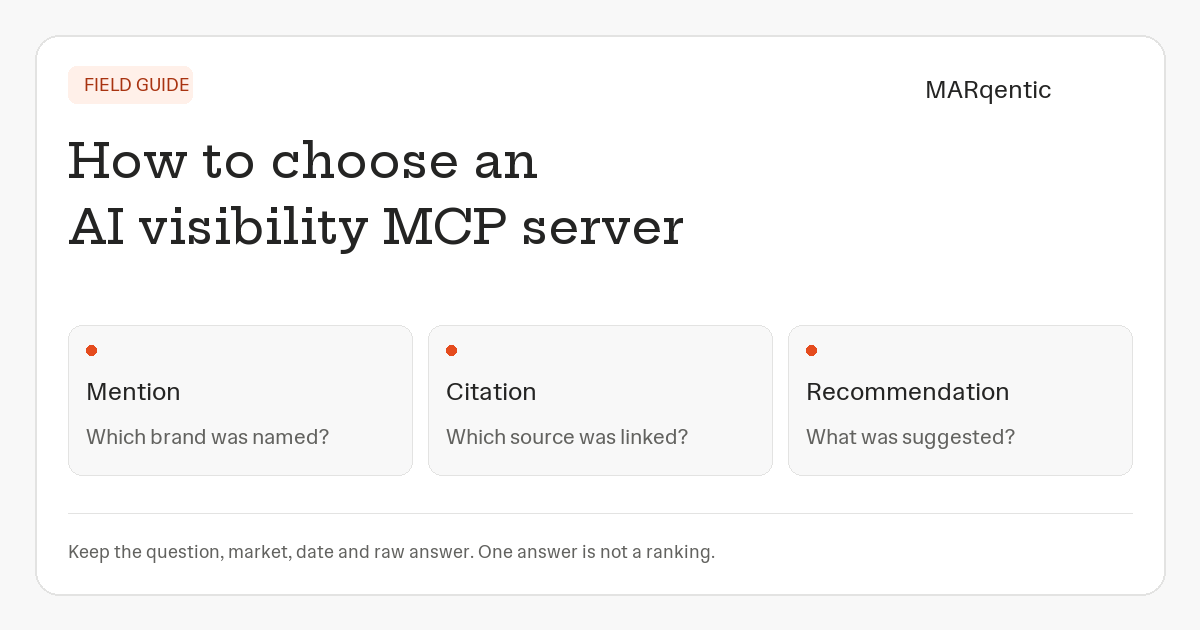
- AI visibility is three separate observations: whether an engine mentions your brand, whether it cites one of your pages, and whether it recommends you for a specific buying question.
- Answers change between runs, so one answer proves little. Look for a server that lets you repeat the same question and keep every raw answer.
- A single visibility score hides the evidence. Prefer a server that returns the answer text, the brands named and the cited URLs.
- Check whether your site lets answer engines read it before measuring visibility. Access restrictions can prevent retrieval; allowing a crawler does not guarantee a mention or citation.
What AI visibility actually measures
When a buyer asks ChatGPT, Claude, Gemini or Perplexity for a recommendation, the answer may name brands, link to sources, or do both. AI visibility tracking records what those answers say about you and your competitors so you can see where you appear and where you do not.
An MCP server brings that tracking into your assistant. Instead of pasting questions into several chat windows by hand, you ask the assistant to run a set of questions on several engines and report back, with the evidence attached.
This is a selection guide published by MARqentic, not an independently tested ranking of servers. Start with the actual tool contracts and search-engine guidance:
| Signal | What it tells you | What it does not tell you |
|---|---|---|
| Mention | The engine named your brand in its answer | That the answer was positive or that anyone clicked |
| Citation | The engine linked to one of your pages as a source | That your brand was recommended |
| Recommendation | The engine suggested you for a specific buying question | That the same answer will appear next time |
What to look for in an AI visibility MCP server
- Engines you can name. Know exactly which engines the server queries, such as ChatGPT, Claude, Gemini, Perplexity and Google AI Overviews, and whether each result comes from a live run or a stored sample.
- Raw answers, not just scores. You need the answer text, the brands it named and the sources it cited so you can read what a buyer would have seen.
- Repeatability. The same question should be runnable again with the same settings, so you can compare this month with last month.
- Location and language control. Answers differ by country and language, so these must be explicit.
- Prices you can see first. Every question on every engine costs something. Choose a server that quotes the cost before it runs.
- Honest failure handling. If one engine fails, the report should say so rather than silently averaging the rest.
Types of AI visibility MCP servers
Answer-tracking servers
Best for: Running your buyer questions on several engines and recording mentions and citations.
Watch out for: Check which engines are covered and whether answers are fresh runs or cached samples.
Search-data servers with AI features
Best for: Teams that already use a search data provider and want AI Overview data alongside keywords and rankings.
Watch out for: AI Overview coverage does not include chat engines like ChatGPT or Claude.
Site-readiness and crawler-access checks
Best for: Finding out whether answer engines are allowed to read your site at all.
Watch out for: Access is necessary but not sufficient. Passing a readiness check does not mean you will be cited.
Observed-prompt servers
Best for: Finding which questions people actually ask AI engines about a topic, so you track the right ones.
Watch out for: Prompt data is a sample from a provider’s index, not every question ever asked.
Where MARqentic fits
MARqentic includes three AI visibility tools alongside its search, social, ad and marketplace research.
- aeo_run_ai_answers runs your prompts on ChatGPT, Claude, Gemini, Perplexity, Google AI Overviews and AI Mode, and reports which brands each answer mentions and which sources it cites.
- aeo_search_prompts finds prompts people ask ChatGPT or Google AI Overviews about a topic or brand, from a provider index of observed answers.
- aeo_get_site_readiness checks whether your site is set up for answer engines, including robots.txt access for known AI crawlers and CDN or firewall rules that can block them.
Pricing is per prompt per engine, and answer runs are never cached, so each run reflects a fresh answer. A dry run quotes the cost before you spend. A failed engine result is not charged. Current credit purchase options are listed on the pricing page; charging per request does not imply that a one-time top-up is always available.
Check availability and funding before choosing a workflow:
A repeatable AI visibility workflow
- Write ten to twenty buyer questions. Include unbranded category questions as well as direct comparisons, because a question that names your brand measures something different.
- Check site readiness first, so a blocked crawler does not distort the results.
- Run the questions on the engines you care about and keep every raw answer.
- Record, for each question, whether you were mentioned, cited or recommended, and which competitors appeared.
- Repeat the same set on a schedule, such as monthly, with the same settings.
- Look for patterns in the sources that get cited, then improve those pages or earn coverage on those sources.
A prompt to adapt
Replace the bracketed items with your own details and ask for the cost before anything runs.
Check whether [domain] is readable by AI answer engines. Then, for [country] in [language], quote the cost of running these buyer questions on ChatGPT, Claude, Gemini and Google AI Overviews: [question 1], [question 2], [question 3]. After I approve, run them and give me, for each question, the answer text, the brands mentioned, the cited URLs and whether [brand] appeared.Worked observation: public access comes before answer tracking
On 18 November 2026, a public HTTP audit of www.marqentic.com returned 200 for robots.txt and its sitemap. The robots file allowed public paths under its wildcard group, and the sitemap listed 95 HTTPS pages on the custom domain. This is a first-party site-access observation, not a test of whether any answer engine mentions or recommends MARqentic.
curl -i https://www.marqentic.com/robots.txt
curl -i https://www.marqentic.com/sitemap.xml

# Observed on 2026-11-18 before this guide update:
# robots.txt: HTTP 200; User-agent: *; Allow: /
# Sitemap: https://www.marqentic.com/sitemap.xml
# sitemap.xml: HTTP 200; 95 canonical-domain URLs
# Counts can change as new pages are published.No research credits were needed for those two public GET requests. They do not verify a crawler’s real IP through a firewall, actual Google indexation or an AI citation. To measure mentions, choose named engines and a market, quote the AI-answer call, and retain its returned answer text, timestamps and cited URLs after execution.
Use these references to interpret or extend the check:
Common mistakes to avoid
- Judging visibility from a single answer instead of a repeated sample.
- Asking only questions that already contain your brand name.
- Reporting a score without keeping the answers behind it.
- Ignoring whether answer crawlers can reach your site.
- Comparing results across different countries or languages.
Questions people ask
What is an AI visibility MCP server?
It is a service that lets an AI assistant run questions on AI answer engines and report which brands and sources appear in the answers. It brings brand mention and citation tracking into your assistant conversation.
Which engines should I track?
Track the engines your buyers actually use. Many teams start with ChatGPT, Gemini, Perplexity and Google AI Overviews, then add Claude and AI Mode as needed.
How often should I measure AI visibility?
Monthly is a sensible start. Answers change, so repeating the same question set on a schedule shows the trend better than a single check.
Can I guarantee ChatGPT will cite my site?
No. Nobody can. You can make your pages accessible and useful, then measure whether engines cite them, but citations are not controllable.
Does AI visibility replace SEO?
No. They overlap, since engines often draw on pages that rank well, but they measure different things. Track both.